
PepsiCo Tests AI-Powered Digital Twins to Optimize Manufacturing Plants and Warehouses
PepsiCo is piloting AI-powered digital twin technology with Nvidia and Siemens to optimize manufacturing plants and warehouse operations, improving throughput, reducing costs, and minimizing supply chain risk.
PepsiCo Accelerates Smart Manufacturing With AI and Digital Twin Technology
PepsiCo is advancing its supply chain digitization strategy by piloting artificial intelligence and digital twin technology to optimize manufacturing plants and warehouse facilities before making physical changes.
The multi-year pilot, launched in partnership with Nvidia and Siemens, focuses on creating physics-accurate, 3D digital replicas of PepsiCo’s U.S. plants and distribution facilities. The initiative aims to improve facility design, increase operational efficiency, and reduce capital risk across the supply chain.

(Image Credit: PepsiCo)
Using Digital Twins to Simulate and Optimize Supply Chain Operations
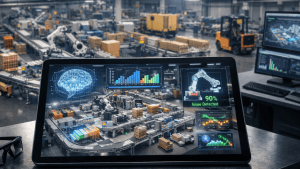
As part of its digital-first planning approach, PepsiCo is using digital twins and AI agents as co-designers of plant and warehouse layouts. The solution leverages Siemens Digital Twin Composer built on Nvidia’s Omniverse AI platform, enabling real-time simulation of production lines, material flow, and labor movement.
A digital twin is a virtual model of a physical asset or operation that mirrors real-world performance. Companies such as Amazon and Walmart already use digital twin technology to test operational changes and improve warehouse efficiency. PepsiCo plans to initially deploy the technology across U.S. facilities, with global expansion planned for major international markets beginning later this year and continuing into 2027.
Measurable Gains in Throughput, Cost, and Design Accuracy
PepsiCo and Siemens have converted selected U.S. manufacturing plants and warehouses into high-fidelity 3D digital replicas. These models capture every machine, conveyor, pallet route, and operator path with physics-level accuracy, establishing a reliable performance baseline for end-to-end supply chain operations.

Early results from the pilot demonstrate significant operational benefits:
-
Up to 90% of potential facility design issues are identified before physical implementation
-
20% improvement in factory line throughput
-
100% design validation prior to execution
-
Up to 15% reduction in capital expenditures
By testing layout changes and system upgrades virtually, PepsiCo can validate decisions faster while minimizing disruption to live operations.
What AI-Powered Digital Twins Mean for Warehousing and Logistics
The pilot highlights how AI and digital twin technology are reshaping modern supply chains. For manufacturers, distributors, and logistics providers, digital twins enable:
-
Smarter warehouse layout and capacity planning
-
Faster throughput optimization without operational downtime
-
Lower capital investment risk
-
More resilient and adaptive supply chain networks
“Working with Nvidia and Siemens, PepsiCo is re-architecting its operations—using physically accurate digital twins and AI to reinvent how it designs, optimizes, and runs its global operations,” said Jensen Huang, founder and CEO of Nvidia.
Building the Future of Intelligent Supply Chains
With AI embedded into facility design and operations, PepsiCo is laying the foundation for a more connected, data-driven supply chain ecosystem.
“With a unified, AI-powered digital foundation, PepsiCo is building toward a world where every plant and warehouse operates as part of a single, intelligent system,” said Athina Kanioura, PepsiCo’s global chief strategy and transformation officer. “In this future, our facilities don’t just respond to demand—they anticipate and adapt to it.”
As digital twin adoption scales globally, PepsiCo’s pilot underscores a broader industry shift toward smarter manufacturing, optimized warehousing, and AI-driven supply chain decision-making.